

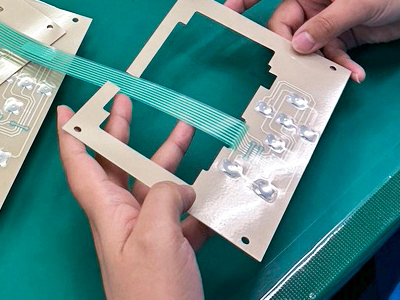
Thin film switches are usually composed of six parts: panel, surface adhesive, upper circuit (spring clip fixing layer), isolation layer, lower circuit, and backing adhesive. The material selected for each layer should be based on the user's requirements, product characteristics, and usage environment, and selected at the beginning of engineering design.
The commonly used panel materials include polycarbonate (PC), polyvinyl chloride (PVC), and polyester (PET). PC material is thermally stable (-60~120 ℃) and environmentally friendly; Excellent heat and cold resistance, electrical insulation, and resistance to atmospheric aging, with superior bending, tensile, and compressive strength; However, it has poor resistance to drugs (organic solvents), poor fatigue resistance, is prone to stress cracking, and is easily oxidized by air to gradually form a peeling layer, which eventually decomposes completely. PC is easy to decompose and widely used in environmental protection field, which can meet the requirements of membrane switch panel. High transparent PC is often used as the lens of display window. PVC is stable to acids, alkalis, and salts at temperature, has good wear resistance, self extinguishes upon ignition, reduces noise and vibration, has good electrical insulation, and poor thermal stability (-20~60 ℃). PVC is rarely used for membrane switches, and is only occasionally used for panel labeling.
PET has good resistance, acid and alkali, is insoluble in general organic solvents, has excellent insulation, heat resistance (-30~160 ℃) and wear resistance, especially bending resistance, strong toughness, high dimensional stability, and is the most ideal substrate for making membrane switch panels and circuits. The sanded PET commonly used for membrane switch panel is Autotype F series (F150, F200) and V series (V150, V200), and the smooth surface is Autotype EBG and EBA series.
Many manufacturers of circuit substrates choose Dongli (imported) and Dongfang (domestic) PET materials. The thickness is mostly 0.125mm, and many light touch types sometimes choose a thickness of 0.10mm, or even 0.075mm. The fixed layer of shrapnel is generally made of PET with a thickness of 0.075mm or 0.05mm from the same series. When the outgoing line spacing of the membrane switch is less than 1.00 mm, FPC or PCB will be considered for the circuit.
The feel of membrane switch often depends on three factors: the size, strength and travel of the shrapnel (pan piece) (the design of the isolation layer and the ventilation slot of the surface glue also affects the feel). The shrapnel is commonly divided into three types: stainless steel, nickel plated and gold plated. membrane switch is usually nickel plated, and gold plated when the key requirements are particularly sensitive and the circuit resistance requirements are very stable. The magnitude of the force is generally proportional to the diameter of the shrapnel. For example, for a shrapnel with a diameter of 8mm, the force should be 180-220 grams, for a shrapnel with a diameter of 10mm, the force should be 220-280 grams, and for a shrapnel with a diameter of 12mm, the force should be 280-350 grams. If the stroke is too low, the hand feel is not good, and if the stroke is too high, it is difficult to press and it is easy for the shrapnel to not conduct when lightly pressed.
The terminal generally uses a female end of 2.54mm (1.27mm is rarely used), and occasionally some users use a male end. The pin spacing is divided into two types: 2.54mm and 5.08mm. A terminal with a 2.54mm foot spacing is convenient for production and has high efficiency. However, it is necessary to check whether the terminal is tightly fastened and conduct a destructive test if necessary to check whether the terminal is easily peeled off. The terminal with a 5.08mm foot spacing will be pressed firmly against the terminal and will not loosen even in vibration environments. In the application end of automotive electronics, there are special requirements for the reliability of the connection. Sometimes, Japanese FCI and DuPont connectors are used, and the connection at both ends of the terminal requires locking buckles. In special cases, the connection is sealed firmly using glue filling technology.

This analysis examines key burnout in BSD-5010-R3-2670 membrane switches, identifying insufficient silver paste line width (0.32mm vs. 0.5mm standard) as the ro...











 Return to List


